
 TripAdvisor reviews
 Google reviews
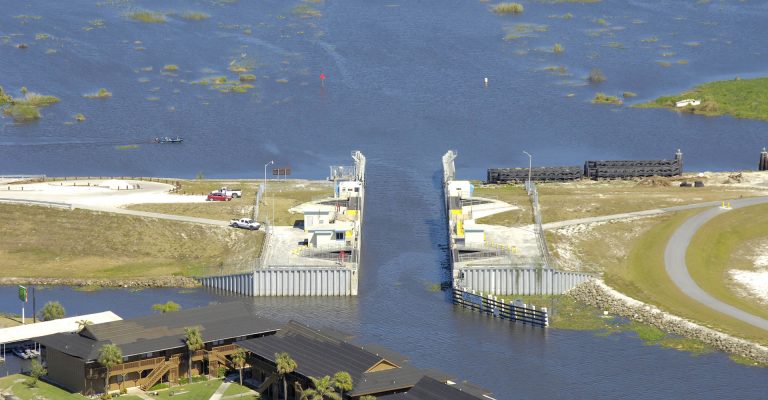
Southwest shore
Clewiston
Closest to Fort Myers, Cape Coral and Naples.
Trips: Bass, crappie and panfish
Today’s official lake level, how it has changed this week and over the last year, and what it means for fishing.
Lake level today · loading
–.–ft
Change this week: loading
Checking the usual 12 to 15 ft range.
30-day low / high—
12-month low / high—
Source: US Army Corps of Engineers, Jacksonville District. If the number does not load, use that link.
Loading the chart…
These are direct live feeds from the US Army Corps of Engineers Website showing the current Lake Okeechobee water levels today as it changes in water levels of Lake Okeechobee. The first feed is the current Water level; it is constantly updating with automatic water level conditions for Lake Okeechobee.
The South Florida Water Management District feed of Lake Okeechobee provides the pump & water flows around Lake Okeechobee, including all depth changes. Here’s a link to the Water Management page.
The chart above shows the daily Okeechobee water level over the last 12 months, so you can compare the high and low months.
The water levels on Lake Okeechobee will fluctuate 6 feet in some years, others a foot or two. The average water levels on Lake Okeechobee range from 12-15 feet above sea level. The average water level on Okeechobee in the summer months ranges from 11-14 feet above sea level. The water levels on Lake Okeechobee mainly rise and lower due to rain or the lack of.
Additional WM Resources: Daily Reports · Graphical Plots · Maps · Okeechobee Waterway Spillway Webcams
Most of the freshwater in Florida runs North to South, making the main replenishing areas between Orlando and Lake Okeechobee.
Because of this, the South Florida Water management controls all the pumps that move water from one place to another. So no matter the navigation level that the corp shows you above, you want to watch these pumps and look at the upstream and downstream levels to know what the water level will be tomorrow. So click the link below to go to live Lake Okeechobee water level by pump flow: SFWMD Lake Okeechobee site status.
Summer months usually bring most of the rain, mainly during average years from afternoon rain showers or either tropical storms and hurricanes. This is when most water levels rise in Lake Okeechobee the fastest. During the winter months, the water levels in Okeechobee will consistently fall from January thru June. The lake fishes, like most rivers…much better on a falling tide vs. a rising tide.
However, with the onset of the dry season, some of that water will eventually have to be released but when? And where?
In November 2022, after Hurricane Nicole, Polk said the Corps dry-season strategy had yet to be finalized. “Before Hurricane Nicole, I could have told you we have a firm dry season strategy. But Nicole, it threw us for a loop. Fortunately, it was at the lower end of the spectrum as far as what we saw from rainfall. Today we’re at 16 and a quarter feet, 16.25. And I’ll tell you in about two weeks I’ll tell you where we’re for a dry season strategy.”
The US Army provides these Lake Okeechobee water levels. Thank you for using our site, and don’t forget to “Add this page to your favorites.”
Every water level has a bite. Pick the launch town closest to where you are staying: bass and panfish trips, 4, 6 or 8 hours, from $350 for two anglers.
Southwest shore
Closest to Fort Myers, Cape Coral and Naples.
Trips: Bass, crappie and panfish

North shore
Closest to Orlando, Port St. Lucie and Vero Beach.
Trips: Bass, crappie, panfish and pontoon
Northwest shore
Near Moore Haven and Buckhead Ridge.
Trips: Bass, crappie and panfish

Southeast shore, Torry Island
Closest to Miami and Fort Lauderdale.
Trips: Bass, crappie and panfish
Send your dates and we will tell you how the lake is fishing at today's level, and which town to launch from.
Your message is on its way. We will be back in touch shortly. Need us sooner? Call or text (863) 777-9848.
The Lake Okeechobee water level decides how much shallow grass and reeds are flooded. Higher water pushes bass back into the cover, while lower water concentrates fish on the outside edges, so your guide adjusts where you fish.
From the US Army Corps of Engineers, which manages the lake and reports the official Lake Okeechobee water level every day. This page updates from that data automatically.
The current level is shown at the top of this page. It is the US Army Corps of Engineers’ official 8-station daily average, in feet above sea level (NGVD 29), and updates every day.
The average water level ranges from about 12 to 15 feet above sea level, and from about 11 to 14 feet in the summer months. In some years the lake moves 6 feet; in others only a foot or two.
Mostly rain or the lack of it. Summer storms and hurricanes raise the lake fastest, the level usually falls from January through June, and the Army Corps and the South Florida Water Management District move water with locks and pumps.
The lake usually fishes better on falling water than rising water. Your guide picks spots for the current level, so you do not need to plan around it.